
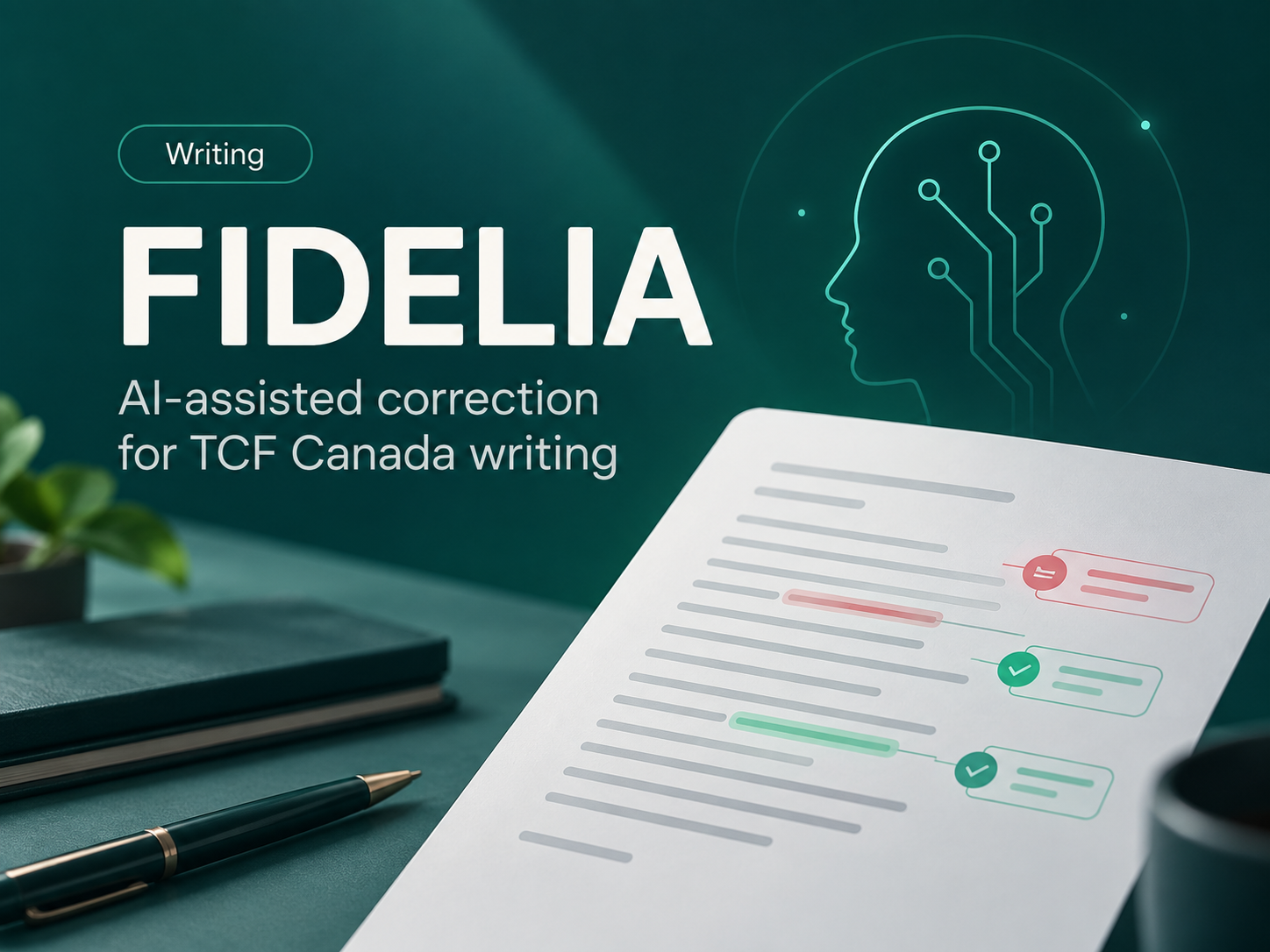
Since 2024, France Éducation international has been progressively using FIDELIA, an artificial intelligence system designed to assist with the assessment of written productions in the TCF. But how does it work, and what does it actually change for TCF Canada candidates?
If you are currently preparing for the TCF Canada, you may already know that the Writing section is assessed according to specific linguistic, pragmatic and sociolinguistic criteria.
What many candidates do not know is that an artificial intelligence system may now be involved in the assessment of their written production.
Its name is FIDELIA.
France Éducation international describes FIDELIA as an automated correction support system for TCF written productions.
The important word here is support.
FIDELIA does not simply replace human examiners.
What Is FIDELIA?
FIDELIA was developed through a collaboration between France Éducation international and CENTAL at UCLouvain, in Belgium.
The research project was initially known as CECR-FR Rator.
Its objective was to develop a system capable of analysing written productions from learners of French and automatically predicting their proficiency level according to the Common European Framework of Reference for Languages, or CEFR.
The researchers worked with written productions from the TCF in order to train algorithms to identify linguistic characteristics associated with different levels of proficiency.
So FIDELIA is not simply a general-purpose chatbot being asked:
“What level would you give this text?”
It is a system specifically developed for language assessment in the context of the TCF.
Does AI Really Correct the TCF Canada?
Yes, but there is an important distinction.
FIDELIA does not completely replace the human examiner.
For certain TCF Writing tests taken on computer, one assessment may be carried out with the help of FIDELIA while another assessment remains human.
If there is a significant difference between the two assessments, an additional human correction may be carried out.
In other words, the system is based on a hybrid assessment process combining artificial intelligence and human expertise.
FIDELIA does not replace the human examiner.
Human assessment remains part of the correction process, and an additional human examiner can intervene when there is a significant discrepancy.
France Éducation international also indicates that candidates’ results are not based exclusively on an automated decision.
So your TCF Canada Writing result is not simply decided by an algorithm.
Why Is Artificial Intelligence Being Used for the TCF?
According to France Éducation international, the development of FIDELIA serves several objectives, including:
- improving the quality and fairness of assessment;
- innovating in the field of language evaluation;
- improving consistency in correction;
- better managing the resources and costs involved in assessing large numbers of written productions.
This makes sense when you consider the scale of an international test such as the TCF.
Two human examiners may occasionally interpret the same production slightly differently.
A properly calibrated automated system can provide an additional and more consistent point of reference.
What Does FIDELIA Look for in Your Writing?
This is probably the question candidates are most interested in.
France Éducation international publicly explains the criteria used to assess TCF Writing, but this does not necessarily mean that FIDELIA independently gives a separate score for each criterion in exactly the same way as a human examiner.
Official TCF Writing assessment includes three major dimensions.
1. Linguistic Competence
This includes elements such as:
- vocabulary range;
- grammatical accuracy;
- spelling;
- sentence structure;
- degree of complexity and elaboration in your language.
A candidate aiming for a higher level therefore needs to do more than simply write short, correct sentences.
At the same time, complexity alone is not enough.
You also need to maintain control of the language.
2. Pragmatic Competence
This concerns the way your text is organised and developed.
Examiners look at areas such as:
- coherence;
- cohesion;
- logical progression;
- development of the topic.
A text can contain relatively few grammatical mistakes and still be weak if the ideas are repetitive, poorly connected or insufficiently developed.
3. Sociolinguistic Competence
This mainly concerns whether your language is appropriate for the communication situation.
You do not write in the same way when addressing:
- a friend;
- your manager;
- an administration;
- readers of a blog;
- your colleagues.
The tone, register, opening and closing formulas should match the situation.
This is one reason why simply memorising a “perfect text” is not enough.
Does FIDELIA Simply Count Your Mistakes?
No.
This is probably one of the biggest misconceptions about automated language assessment.
The objective behind the research project that led to FIDELIA is to predict a candidate’s level of written proficiency according to the CEFR, not simply count spelling or grammar mistakes.
Two texts can contain the same number of errors and still represent very different proficiency levels.
For example, a B2 candidate may attempt more complex structures and make several mistakes while still demonstrating a much wider range of language.
An A2 candidate, on the other hand, might write very simple sentences with relatively few mistakes.
That does not automatically make the second text stronger.
Language assessment is therefore much more complex than:
“Three mistakes = B2, eight mistakes = B1.”
That is not how the TCF works.
Can You Refuse to Have FIDELIA Involved in the Assessment?
The TCF candidate documentation explains that certain Writing tests taken on computer may involve automated correction support through FIDELIA alongside human assessment.
It also indicates that candidates who do not wish to have their written production processed through this automated correction system may request to take the TCF on paper, provided the test centre offers that option.
That means FIDELIA is mainly relevant to computer-based written productions.
What Does FIDELIA Change for Your TCF Canada Preparation?
In reality, it should not completely change the way you prepare.
Your objective remains the same.
You need to learn how to produce writing that is:
- clear;
- coherent;
- grammatically controlled;
- appropriate for the recipient;
- sufficiently developed;
- lexically varied;
- fully relevant to the task.
However, the use of a system such as FIDELIA reinforces the importance of developing real language skills rather than relying entirely on memorised texts.
Consider a candidate who learns an introduction such as:
“Nowadays, this topic generates a lot of debate in our society. Some people believe that…, while others think that…”
There is nothing wrong with learning useful structures like this.
They can help you organise your ideas.
But if you memorise twenty generic sentences without being able to adapt them naturally to a new topic, that does not necessarily demonstrate the level of French required for B2 or C1.
The goal should be to learn how to build your own text, not simply reproduce a prepared one.
Are Templates Still Useful?
Yes.
Templates can be extremely useful when they are used correctly.
For Task 2, for example, a structure such as:
introduction → experience → details → personal opinion → conclusion
can help candidates organise their writing.
For Task 3, you might use:
presentation of the documents → comparison → personal position → arguments → conclusion
The problem begins when the template becomes a memorised text that the candidate cannot adapt.
A good template should give you a framework.
It should not write the answer for you.
In my classes, I prefer to teach students how to automate the structure of their writing while still developing their own vocabulary, examples and arguments.
That makes them much more flexible on exam day.
Does Grammar Become Even More Important?
Grammar has always been important.
But grammar alone does not determine your level.
You may write a grammatically acceptable text and still remain around B1 if:
- your vocabulary is too limited;
- your sentence structures are always the same;
- your ideas are underdeveloped;
- your connectors are repetitive;
- your arguments are vague;
- your register is inappropriate.
The opposite is also true.
Trying to write extremely sophisticated sentences that contain major grammatical errors is not automatically a good strategy either.
The real objective is to gradually increase the complexity of your language while maintaining control and accuracy.
Should You Try to “Write for the AI”?
I would not recommend it.
We do not publicly know every internal parameter used by FIDELIA to analyse a written production.
Trying to guess how to “please the algorithm” would therefore be highly speculative.
The safest strategy is still the same strategy that works with human examiners:
develop a genuine level of French.
Focus particularly on:
- grammatical variety;
- vocabulary precision;
- logical connectors;
- coherence;
- argument development;
- appropriate register;
- reformulation;
- strict respect of the task instructions.
These are all central dimensions of TCF Writing assessment.
Will AI Eventually Replace Human Examiners Completely?
At this stage, there is no official basis for saying that it will.
The current system described by France Éducation international is intentionally based on a combination of artificial intelligence and human expertise.
FIDELIA is presented as an assessment support tool, not as the complete replacement of human examiners.
Technology may continue to evolve, but it would be premature to claim today that the TCF will eventually be corrected entirely by artificial intelligence.
What Should TCF Canada Candidates Remember?
FIDELIA represents an important development in the way written language assessment is being carried out.
For certain computer-based TCF Writing tests, a human examiner and FIDELIA may both participate in the double-assessment process, with an additional human assessment possible when the results differ significantly.
But for candidates, the main lesson remains simple:
Do not focus on memorising a perfect text. Focus on learning how to write well in French.
A strong TCF Canada preparation should help you:
- understand the task;
- adapt to the communication situation;
- organise your ideas;
- use appropriate vocabulary;
- control your grammar;
- produce a clear, coherent and sufficiently developed response.
Whether your production is assessed by a human examiner, analysed with the assistance of FIDELIA, or assessed through a combination of both, those are the skills that ultimately matter.